
For Vancouver homeowners who need the equity from their current home to fund their next purchase, selling first is often the more manageable financial choice. Buying first may make sense when the next home is difficult to find and you have lender-approved financing, accessible cash, and enough flexibility to carry both properties if your sale takes longer than expected.
The right order depends on two questions: How much uncertainty can you afford on your sale, and how difficult will it be to find your next home?
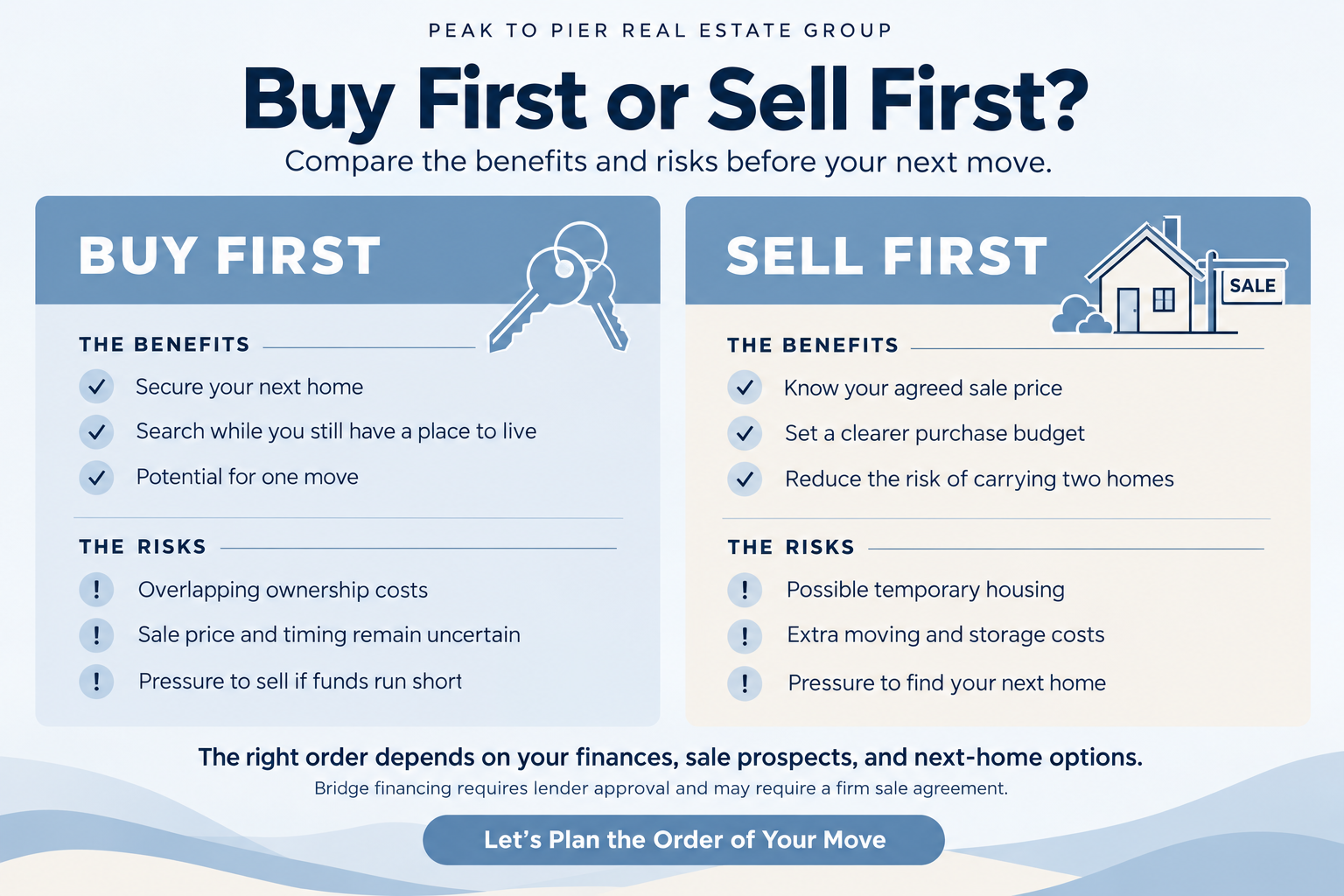
Buy first vs. sell first: a quick comparison
Neither option guarantees a smooth move. The goal is to choose the uncertainty you can realistically manage.
Benefits and risks of selling first
Selling first gives you a clearer starting point. Once you have a firm sale, you know the agreed price and can estimate your available equity after the mortgage payout, selling expenses, legal costs, and any applicable mortgage penalty.
That can help you set a purchase budget without relying on an optimistic valuation. You also avoid having a new purchase deadline dictate how quickly you must accept an offer on your current home.
The trade-off is housing uncertainty. If you do not find a suitable property before you must move out, you may need a rental, storage, or a stay with family. You could also feel pressure to compromise on location, layout, or price.
Selling first deserves serious consideration if:
You need the sale proceeds for your next purchase.
Carrying two properties would strain your monthly budget.
Your home may take time to sell.
You can arrange temporary accommodation if necessary.
A firm sale improves planning certainty, but the funds are not available simply because an offer has become unconditional. Your lender and conveyancing professional need to confirm when the proceeds can fund your purchase.
Explore our approach to selling a home in Vancouver.
Benefits and risks of buying first
Buying first gives you time to find a home that suits your needs while you still have somewhere to live. That can be valuable if you need an uncommon layout, a specific school catchment, accessibility features, or a particular type of townhouse.
You may also be able to move into the new property before preparing your current home for sale, if your financing and contracts allow it.
The main risk is committing to a purchase before knowing your actual sale proceeds. If your home sells for less than expected or takes longer to sell, you may face a funding shortfall, overlapping expenses, or pressure to reduce your asking price.
Budget for more than two mortgage payments. Overlap can include property taxes, strata fees, insurance, utilities, maintenance, and additional borrowing costs.
Buying first is worth exploring when:
Suitable replacement homes are genuinely difficult to find.
Your lender has assessed the proposed overlap.
Your deposit and closing funds are accessible when required.
You can handle a slower sale and a lower sale price.
Your current home is ready to list promptly.
Our guide to buying a home in Vancouver explains the steps from preparation to possession.
An estimated sale price is a planning assumption, not money you can rely on receiving.
Financing and bridge-financing questions
Before choosing an order, ask your lender or mortgage broker to assess both scenarios.
Bridge financing may cover a short gap when your new purchase completes before the proceeds from your existing home become available. It is not automatically available just because you own a home with equity. For example, RBC requires a firm sale agreement on the existing property to qualify for its bridge loan, and lending approval still applies.[1]
Buying before you have sold and completing a purchase before your sale closes are different financing problems.
Ask your lender:
Can I qualify for the purchase while still owning my current home?
Must my current home have a firm sale agreement?
What amount and length of overlap would you approve?
What interest, fees, and legal costs would apply?
Does my mortgage offer portability, and what conditions or penalties apply?
Where will the purchase deposit come from before sale proceeds arrive?
What happens if my sale is delayed or the buyer fails to complete?
Have your lawyer or notary confirm the movement of funds and completion requirements. A mortgage pre-approval alone does not answer every question about a specific purchase and sale.
Can you make an offer subject to selling your home?
A subject-to-sale condition can make your purchase conditional on selling your existing property within an agreed period. The wording should address your circumstances and the required stage of your sale.
The seller does not have to accept it. A seller may also negotiate a time clause that allows them to continue marketing and require you to remove conditions within a specified notice period. Your rights and deadlines depend on the actual contract.[2]
This can create a difficult choice if another buyer appears before your home sells. Do not remove the condition unless you understand the obligation and have confirmed how you will fund the purchase.
BCFSA explains that accepted contracts are legally binding even when they contain subjects, and that subject clauses are not general escape clauses.[3] Ask your REALTOR® to explain the terms and seek legal advice where needed.
Completion and possession-date strategies
Completion is when legal ownership transfers. Possession is when you can move in or take control of the property. These dates can be different.[4]
Useful strategies to discuss include:
A longer completion period on your sale: More time to shop, if the buyer agrees.
Selling and completing before purchasing: Sale proceeds can become available first, but housing may be needed between homes.
Completing your purchase first: May provide moving time, but requires approved funding for the overlap.
Negotiated possession arrangements: May help with the move, provided the terms are properly documented.
Avoid assuming that two completions on the same day will be straightforward. BCREA identifies same-day funding risks and recommends staggering purchase and sale completions by at least one to two business days to reduce delays.[5] Your lawyer or notary should advise on the dates appropriate for your transactions.
If you are considering staying in your old home after completion, obtain legal advice on the arrangement, including occupancy terms, insurance, liability, and any tenancy implications.
Temporary housing and storage
Temporary accommodation can make selling first workable, but it belongs in the budget from the beginning.
Price out accommodation, two moves, storage, deposits, pet restrictions, parking, and commuting. Consider school routines and whether the arrangement would still work if the search took longer than planned.
Compare the total cost of temporary housing with the total cost and risk of owning both properties. The easier option emotionally is not always the more affordable one.
How property type and market conditions change the decision
Your current home and your next home may be in very different markets, even within Vancouver.
A homeowner selling a condo and buying a detached house should assess each segment separately. A downsizer looking for a specific accessible condo may face a narrow selection even when there are many other condos for sale.
Review recent comparable sales, competing listings, time on market, price reductions, and the number of suitable replacement properties. Also consider property-specific factors such as condition, strata finances, upcoming levies, and unusual layouts.
As a planning principle, selling first becomes more attractive when your sale is uncertain and replacement options are plentiful. Buying first becomes more attractive when suitable replacements are scarce and you can comfortably fund the overlap. These are decision guides, not guarantees about how either property will perform.
For a more informed starting point, request a home evaluation before setting your next purchase budget.
A decision checklist before you commit
Before accepting a sale or making a purchase offer, confirm:
A realistic sale-price range and estimated net proceeds.
A purchase budget based on a conservative sale outcome.
Lender approval for the proposed sequence and any overlap.
Cash available for deposits and closing costs.
Your maximum affordable period of carrying two homes.
A practical temporary-housing and storage option.
Completion and possession dates reviewed with your professionals.
A contingency plan for delays in either transaction.
If the move only works when your home sells immediately for your highest expected price, revisit the plan before committing.
Frequently asked questions
Is it better to buy or sell first in Vancouver?
Selling first often makes sense when sale proceeds are essential and financial overlap would be stressful. Buying first may suit homeowners with confirmed financing and a hard-to-find replacement home. Assess both properties and your finances together.
Can I buy a home before selling my current one?
Possibly, but you need to confirm how you will qualify, pay the deposit, and fund completion. Do not assume that expected equity or a future sale will satisfy your lender.
Does bridge financing let me buy before my home sells?
Not necessarily. A lender may require a firm sale agreement before approving a bridge loan. Confirm its requirements before making commitments.[1]
Will a seller accept an offer subject to sale?
They may, but acceptance depends on their circumstances, competing offers, and the terms proposed. A negotiated time clause may limit how long your conditional purchase remains in place.[2]
Can I sell and buy on the same day?
It may be possible, but coordinating funds creates risks. Have your lawyer or notary review the dates and any required financing before agreeing to the schedule.[5]
What if I sell first and cannot find a home?
A longer negotiated completion period may help, but it cannot guarantee you will find a property. Have a workable temporary-housing plan so you are not forced into an unsuitable purchase.
Let's Plan the Order of Your Move
Your sale, purchase, financing, and moving dates should work together.
At Peak to Pier Real Estate Group, we can help you assess your current home's likely market position, explore suitable replacement homes, and compare buying first with selling first. With input from your lender and legal professional, we can build a sequence around your budget and priorities.
Planning a move in Vancouver?
This article provides general information. Financing eligibility and contractual obligations depend on your circumstances, lender requirements, and the terms of your agreements.
Sources
[1] RBC Royal Bank — Bridge Financing
https://www.rbcroyalbank.com/mortgages/product-advice/bridge-financing.html
[2] BCFSA — Clauses, Subject to Selling/Buying
https://www.bcfsa.ca/preview-link/node/385/e6e4df29-9314-4249-ab12-af19db863236
[3] BCFSA — Offers to Sellers
https://www.bcfsa.ca/public-resources/real-estate/buying-home/offers-sellers
[4] BCFSA — Completing Your Purchase
https://www.bcfsa.ca/public-resources/real-estate/buying-home/completing-your-purchase
[5] BCREA — Understanding the Conveyancing Process, Part Two
https://www.bcrea.bc.ca/legally-speaking/understanding-the-conveyancing-process-part-two-583/

 The data relating to real estate on this website comes in part from the MLS® Reciprocity program of either the Greater Vancouver REALTORS® (GVR), the Fraser Valley Real Estate Board (FVREB) or the Chilliwack and District Real Estate Board (CADREB). Real estate listings held by participating real estate firms are marked with the MLS® logo and detailed information about the listing includes the name of the listing agent. This representation is based in whole or part on data generated by either the GVR, the FVREB or the CADREB which assumes no responsibility for its accuracy. The materials contained on this page may not be reproduced without the express written consent of either the GVR, the FVREB or the CADREB.